Wednesday, September 18, 2019

Move More, Eat Healthy, Keep Prostate Problems at Bay


After a certain age, most people are admittedly telling you about your prostate, "Go get checked and screened!" or "Talk to your urologist!" But with stigma and skepticism behind treatments with risky side effect profiles, not many men may be talking about the prostate as much as they could.

Many times men are compared to women in how illness gets talked about. Women are more likely to talk about their health issues with family and friends, more likely to seek knowledge about health issues, more likely to see the doctor, and so on, with men falling behind in those departments. Is it because talking about uncomfortable symptoms (peeing a lot) and even mentioning the word "prostate" sound embarrassing and awkward? Could be. The stereotype is that men talk more about cars than their health.

The older a man gets, the more likely the prostate will develop some kind of issue (BPH, prostatitis, prostate cancer, etc.).

So how do we get men to care for their prostate aside from promoting free health screenings? Tell them to live a healthy lifestyle. Eating well, being more active, reducing stress and excess weight, reducing and/or eliminating tobacco and alcohol consumption, reducing or eliminating unprotected sex with multiple partners, and caring for their mental health are ways men can improve lifestyle. It might sound obvious, but living a healthy lifestyle may help reduce the risk or aggravation of problems with the prostate. Genetics of course are out of our control, but the way we live our lives is not. Even if you don't want to say to your bro, "take care of your prostate!" You could at the very least say, "take care of yourself!"

Tuesday, September 17, 2019

Educate Yourself on BPH Symptoms

When it comes to non-cancerous growth of the prostate (benign prostatic hyperplasia, also known as BPH) if prostate cells grow enough, they could potentially block the urethra, making the passing of urine difficult. The prostate could squeeze the urethra or push against the bladder. Although both conditions can occur at the same time, BPH does not cause prostate cancer.

Symptoms include increased frequency of urination, trouble with urination, pain while urinating, burning sensation while urinating, or a weak urinary flow.

When these symptoms manifest, it's important to talk to your doctor rather than self diagnose. In addition, frequent urination doesn't always mean it's automatically a prostate problem. Age, diet, and other factors play a role in how men's bodies manifest different conditions.

Of course, there are also men who may live a long life with minimal symptoms or be asymptomatic. Since we cannot scan our own bodies, the catalyst for many men to get checked is the interference with quality of life. Are you having to get up to go to the bathroom more often, especially at night? Are you not able to relieve yourself comfortably? There are concerns on whether getting checked regularly or over screening is causing more harm than good, so it's good to educate yourself, and look at guidelines set by the councils that govern health.
 

Monday, September 16, 2019

Prostate Health: Active Surveillance vs Watchful Waiting


When it comes to prostate health checkups, some men are wary of getting an exam or screening due to the possibility of false positives/negatives. However, it's also important for men to know their options if they get a possible diagnosis. There are also cases in which some men cannot receive aggressive forms of treatment. This is when men may agree with their urologist to try Active Surveillance or Watchful Waiting.

What are these two modes of action and what is the difference?
Active surveillance is a way for the doctor and patient to observe the progress of the prostate problem using routine checkups and testing, imaging and/or biopsies. The doctor can see the patient and recommend the next steps.

Watchful waiting, unlike active surveillance, does not have as many routine tests, but the surveillance part is certainly similar. The urologist may perform a digital rectal exam and blood tests for PSA levels.

To minimize side effect risks, these two modes of action may be right for you, but before jumping to a decision, it is best to get your doctor's opinion, and maybe even a second opinion. When a man gets a medical diagnosis, it could be a shock emotionally, and although some men may avoid outwardly expressing their concerns, it could be good to see a counselor or speak to other trusted people (family, friends, support group, other prostate health patients).

This month it is important to get educated and if you are financially struggling, seek resources in hospitals and support centers. Even if you're financially well to do, it could be good to take this opportunity to raise awareness.

Friday, September 13, 2019

No Fear of Prostate Health This Friday the 13th!

Friday the 13th has a scary reputation, and the superstitious crowd might be especially wary. But when it comes to prostate health, we can work together so that men can live their lives without fear.

Knowledge is power so read up on the latest studies concerning prostate health and treatments to prostate related conditions. What are the side effect profiles? How effective is the treatment? Who sponsored the study? How many times has it been replicated, if it all? Is the risk worth the potential benefit?

Discussion and social gathering is another key. Men have feelings and shouldn't be afraid to talk about them. Confiding and talking to others rather than bottling it all up can be beneficial to both physical and mental health. Listening to the men in our lives and giving them a platform for their voice is important. Give men a comfortable space to be part of so they have the courage to open up about their symptoms, pain points, accomplishments, and help them relieve their fears.

With knowledge and power, Friday the 13th doesn't have to be filled with fear of prostate problems anymore!

Thursday, September 12, 2019

Prostate Health in September

We're approaching the middle of September. Do you know someone with prostate health issues? You may have been diagnosed or you may know someone without realizing. How do we make the visit to the urologist less unpleasant? Having a welcoming environment for men (where they feel like they're at the doctor and more like they're in a safe haven) can help ease the mental uncertainty. Whether they're surrounded by sports memorabilia, cars and watch magazines, or any other popular imagery for men, giving them a space to feel relaxed, surrounded by brothers who can offer support is one way to tackle the stigma.

Hosting events and having the proceeds go to men's health orgs and research, health fairs that offer free screenings for men, and other reputable organizations in service of men's health is another idea to include men in a relaxing space while also supporting their health. Imagine playing a fun basketball charity game or a poker night for a cause.

The world has 7.5 billion people, so certainly even if only a portion of us came together for this cause, we can make a bigger impact than we think. Support the education and awareness of prostate health in your local circles!

Tuesday, September 10, 2019

Watch Out! Prostate Problems Will Occur Someday! Part 3 of 3

Welcome Back to Watch Out! Prostate Problems Will Occur Someday!
This week we are going to discuss surgery to resolve BPH and how adjust lifestyle to prevent BPH.

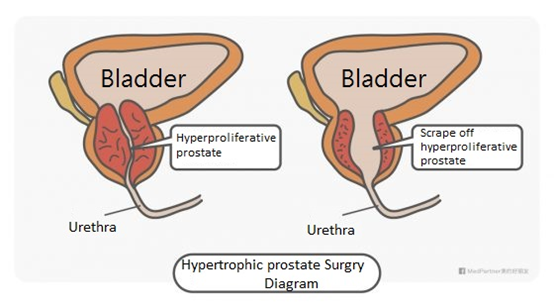
For patients with severe symptoms and less improvement by drugs, surgery is a must. The common practice is called transurethral resection of the prostate (TURP). In short, it is to put a tube into the urethra via an endoscope, slowly push it until it is near the prostate, and then scrape off the hyper-proliferative prostate to improve the compression of the urethra and bladder.
Hypertrophic prostate surgery diagram
There are three common surgical methods at present:
Monopolar TURP
Bipolar TURP
Laser prostatectomy
The main advantage of lasers is less bleeding of the wounds. In order to reduce bleeding and increase the safety of the surgery, people who have heart disease, abnormal blood coagulation or abnormal renal function are recommended to choose this method. However, according to research, using Bipolar TURP is not worse than laser surgery. It is important to find a doctor who is serious, skillful and considerate for the patient.
If you have mild benign prostatic hyperplasia there is no need for treatment, but the following adjustments to your lifestyle can slightly improve the symptoms:
Drink water but not excessively (you can drink 1500-1800 c.c. a day); try to drink during the day and drink less at night.
Train your bladder not to go to the toilet immediately when you want to urinate (distract yourself and try to accumulate up to 200 c.c. or more to improve urine storage function as best as you can).
Do Kegel exercises in your free time (try to purposely interrupt the urine when you are urinating as part of the exercises).
Avoid drinking or eating spicy things; avoid stimulating the sympathetic nerves or cause the symptoms to worsen.
Eat more fruits and vegetables; avoid constipation (the rectum is behind the prostate, so constipation will suppress the prostate).
Pay attention to drug use: some drugs may cause symptoms to worsen (such as antispasmodic drugs).

Many people wonder if there is anything they can eat to improve prostate hypertrophy. Currently there is only evidence that lycopene can improve symptoms slightly. The human body cannot synthesize lycopene by itself, so we can only intake lycopene from food. The content of lycopene in red and yellow vegetables and fruits is relatively high (for example, tomato, papaya, watermelon, etc.). These fruits and vegetables can be taken in moderation. Lycopene is also a good antioxidant, which is somewhat helpful to the human body.

In sum, we hope everybody can understand this common situation well. Prostate hypertrophy is not a taboo disease, and it is a disease that most people may face. Thanks to the advancement of modern medicine, there are already many cheap and effective treatments. Don’t be shy; take good care of your health so that you can have health and happiness in your life.

References:
Berry, SJ, Coffey, DS, Walsh, PC, et al. The development of human benign prostatic hyperplasia with age. J Urol 1984;132:474.
Medical treatment of benign prostatic hyperplasia, UptoDate
Clinical manifestations and diagnostic evaluation of benign prostatic hyperplasia, UptoDate
Transurethral procedures for treating benign prostatic hyperplasia, UptoDate
Medpartner.club-benign prostate hyperplasia cause treatment

Monday, September 9, 2019

Watch Out! Prostate Problems Will Occur Someday! Part 2 of 3

Good to see you again.
Last week we talked about whether you have benign prostatic hyperplasia or not.
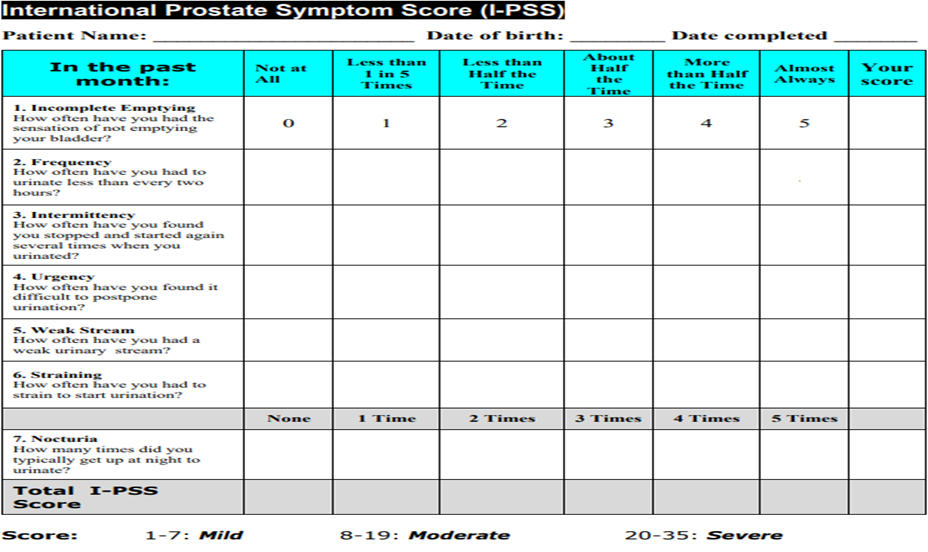
Let's look at the picture:
IPSS questionary
The prevalence of benign prostatic hyperplasia is high, so there is an international questionnaire to find out if you have benign prostatic hyperplasia or not.
If the answers don’t get a score of 0 then by default the score is 5. The maximum possible score is 35 points.
If the result is moderate or even worse, we suggest you see a doctor.

Generally, the doctor may arrange a physical inspection:
Urine routine examination (to exclude the possibility of infection)
Digital rectal exam (because the prostate is in front of the rectum, it can be touched when diagnosing.)
Ultrasound inspection (to observe hypertrophy of the prostate more clearly)
Urodynamic examination (to evaluate the condition of urination)
These examinations are not only to determine whether there is a problem with hypertrophy of the prostate but also to rule out other possible diseases by arranging other blood tests.


Benign Prostate Hypertrophy treatments include oral medication, extracorporeal shockwave therapy and surgery.
If the prostate gland is so big that it affects quality of life, it is necessary to treat it for BPH.

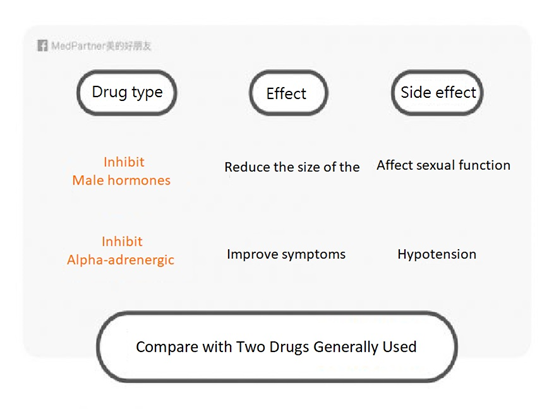
There are two types of commonly used drugs. The first is to inhibit male hormones which can reduce the size of the prostate gland but the side effect is that it may affect sexual function. The second is to inhibit alpha-adrenergic receptors which can improve symptoms but the side effect is hypotension. Which drug should be used depends on the physician’s evaluation and discussion with the patient. If you are really worried about the impact of sex, you should avoid the first drug. If you have high blood pressure, you can use the second drug to reduce blood pressure due to its side effects.compare with two drug generally used to against BPH
Please look forward to the next article.
We'll talk about surgery for BPH.
See you next time~